
8bbfac56f40e7619a98963b35408ac627528a507
Members of The Church of Jesus Christ of Latter-day Saints will study the Old Testament in 2026.This story appears here courtesy of TheChurchNews.com. It is not for use by other media.
By Kaitlyn Bancroft, Church News
When someone talks about history, they’re really talking about stories.
That’s what makes the Old Testament so approachable, said Seminaries and Institutes of Religion teacher Aaron Coombs.
“Stories, for all of eternity, have been the things that resonate with humans,” Coombs said. “They’re the things that we tend to really understand. … And so one of the beautiful things is that anyone can approach the Old Testament in terms of ‘These are really powerful stories.’ They’re interesting. They can grasp your attention. So you can be a beginner and learn something from these stories.”
Coombs recently spoke with Church News about how members of The Church of Jesus Christ of Latter-day Saints can prepare to study the Old Testament in 2026 for “Come, Follow Me” at home and church.

Coombs said that focusing on gospel principles like covenants and the Atonement of Jesus Christ can help people understand thousands of years of history and cultural context found in the Old Testament’s sacred texts.
He also emphasized that the goal of any scripture study is to become closer to Heavenly Father and Jesus Christ. Tools like podcasts, manuals and other study resources can be useful, he said, but shouldn’t replace the scriptures’ “primary purpose” of growing in discipleship.
“If I keep that as my goal and use that as my measure, then I can pull from all kinds of places,” Coombs said. “I can be using material from everywhere, and it will help me to deepen my study. But … remember, the whole purpose of this is to say, ‘How can I connect with heaven again?’”
Cultural and Historical Context
While spiritual principles are the most important learnings in the Old Testament, Coombs highlighted ways that having cultural and historical understanding can deepen an individual’s study.
For instance, he referenced a scripture found in Doctrine and Covenants 1:24, which notes that God speaks to His servants in their weakness, “after the manner of their language.”
Those two qualifiers — weakness and language — are important, Coombs said, because they mean that any time God speaks to His prophets, He’s speaking to humans with specific worldviews, cultural understandings and shortcomings.
“And all of those come into play when we’re talking about the Old Testament. … Just as today we would say you get culture shock going to a different country, that’s magnified on multiple levels when you’re talking about the Old Testament,” Coombs said.
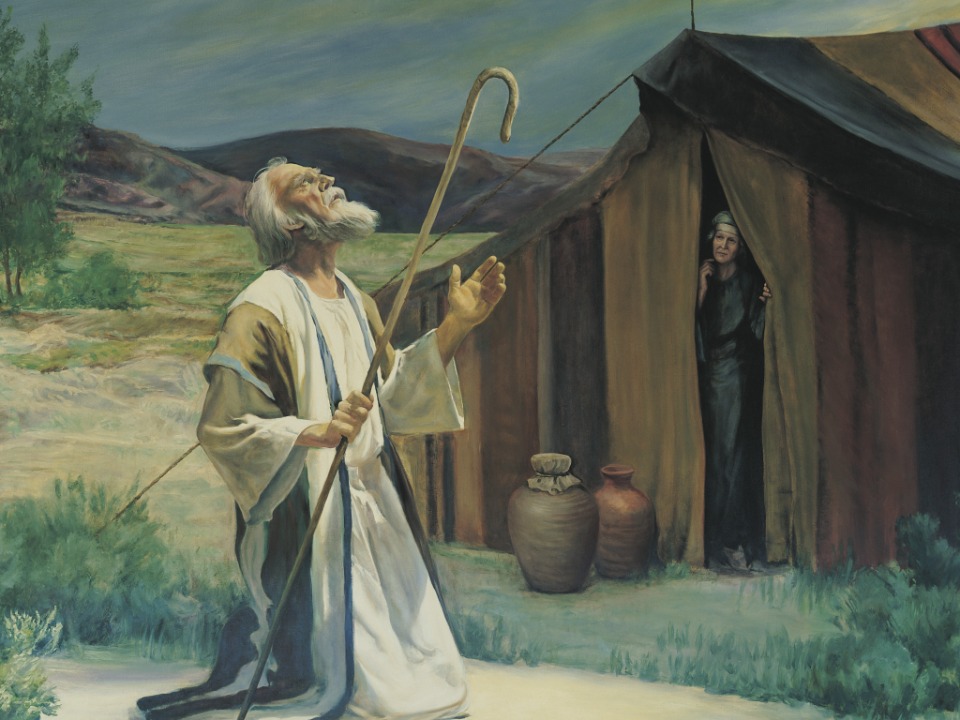
Old-testament-verses-2.jpeg
“Abraham on the Plains of Mamre” is by Grant Romney Clawson. © 2025 by Intellectual Reserve, Inc. All rights reserved.Better understanding these differences, then, can be key to understanding that eternal truths are the same across cultures and time periods, he continued.
Coombs highlighted that people in Old Testament times relied on group living for survival. They lived or died based on family and societal relationships, Coombs said, with exile being the worst thing that could happen to an individual. That’s why Abraham, for example, is so unique — “he’s out on his own and becomes the father of a nation.”
Additionally, people in Old Testament times didn’t have a word for “religion,” Coombs said. To them, religion and everyday life were the same; if lightning struck, for instance, the only explanation was God.
“They live and breathe in a world that they constantly have to be in interaction with,” Coombs said. “We separate ourselves from that world. We get … air-conditioned rooms, and we have lights that turn on, and we don’t see darkness all the time.”

This mindset can bring new insight to stories like Earth’s creation, found in Genesis. Coombs said that modern audiences sometimes argue over how God created the earth, but for ancient people, the more important question was why God created the earth.
Through that lens, Coombs said, the creation story culminates with the creation of humans — and not only that but the creation of humans in God’s image.
“In the ancient world, when you took on someone’s image, your job was to act and behave like them, to reflect them,” Coombs said.
He continued: “[God] was asking Adam and Eve to be mirrors to reflect Him into the world. We actually see this in the Book of Mormon, if you think about Alma 5:14, for example, where it says, ‘Have ye received his image in your countenances?’ So from the very beginning, humans are set out as being the image bearers of God, to be like God, act like God and to reflect His purposes into the world.”
Teaching Children and Youth

6bbf533e8ea16240970c29cb78c42756014ff3d7
Young men and women participate in an institute class held at the Antofagasta Institute of Religion in Antofagasta, Chile.© 2025 by Intellectual Reserve, Inc. All rights reserved.While studying the Old Testament on spiritual, historical and cultural levels is wonderful, Coombs acknowledged that engaging children and youth with the Old Testament can be challenging.
So for parents and teachers, he recommended focusing on stories. Ask children and youth to identify the moral of a story, he said, or invite them to retell a story. Parents and teachers could even create opportunities for roleplaying.
However, he cautioned parents and teachers to not get lost in the stories themselves.
“Remember the stories have a purpose to them. … The story is the vehicle to help us understand what the meaning is,” Coombs said.
He also said that Heavenly Father expects parents and teachers to simply love the learners in their care and to try their hardest. Don’t unload all of the information at once, he said, but seek revelation about what these particular youth or children need.
“Your worry is not a sign of your weakness. It’s actually an opportunity for revelation,” Coombs said. “And so, start turning to Heavenly Father and trying to figure out what He wants you to teach and what is needed. …
“The point is not to teach everything. It’s to teach the thing that will most help the people that you have been called to teach.”
Copyright 2025 Deseret News Publishing Company.