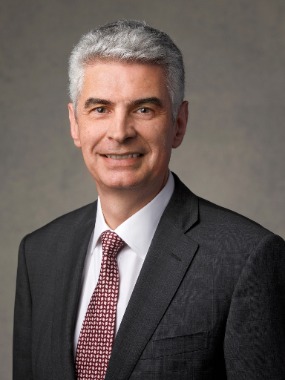
 Download Photo
This speech was delivered at Brigham Young University in Provo, Utah, on Friday, November 14, 2025, to hundreds gathered for two separate conferences — one on environmental stewardship and the other on stewardship to care for those in need. See a news summary of this event.
Introduction
With heartfelt gratitude, I welcome the opportunity to join this combined gathering of two BYU conferences dedicated to the sacred principle of stewardship — our responsibility to care for God’s creations and our covenant duty to help His children in need.
Obviously, much has changed since I first received the assignment to give this talk. I originally prepared these remarks as the Presiding Bishop, but I now have the sacred privilege of sharing them as a member of the Quorum of the Twelve Apostles. While I will touch on various aspects of the Church’s temporal operations and offer a few examples drawn from my previous service in the Presiding Bishopric, my foremost desire this morning is to bear witness of Jesus Christ and His doctrine as one of His ordained Apostles. I love our Savior and testify of Him — even Jesus Christ — that “His way is the path that leads to happiness in this life and eternal life in the world to come.”1
It is a joy to see so many of you — students, scholars and professionals from diverse backgrounds — united by a common purpose. I am deeply grateful for your personal commitment to live and share Christlike values in your schools, congregations, workplaces and communities. I also extend sincere appreciation for BYU’s leadership in fostering gospel understanding, civic responsibility and compassionate service on this campus and throughout the world.
God’s Work of Creation
I love the account in the first chapter of the Book of Moses, which portrays an intimate, sacred conversation between God and Moses. God lovingly addressed Moses as “my son” and revealed before his eyes a portion of His magnificent creations — the earth and all its inhabitants.2 Filled with wonder, Moses asked: “Tell me, I pray thee, why these things are so, and by what thou madest them?”3 God replied: “For mine own purpose have I made these things. … And worlds without number have I created; and I also created them for mine own purpose; and by the Son I created them, which is mine Only Begotten.”4 Then, the Eternal Father declared the purpose of Earth’s creation in this foundational verse: “For behold, this is my work and my glory — to bring to pass the immortality and eternal life of man.”5
That says it all! The creation of this magnificent world was never an end in itself — it is the means by which our Heavenly Father’s eternal designs can be fulfilled. This earth and all that it contains — mountains and caves; deserts and tundra; oceans and forests; the endless variety of plants, insects, birds, and animals — everything, absolutely everything, was created for one sacred purpose: to provide the setting where God’s children could learn, choose righteousness and ultimately inherit immortality and exaltation within eternal families.
This earth — and the heavens that surround it — was organized as a vast and majestic stage for the mortal chapter of our eternal journey. Into this creation, God placed every temporal element needed for our success: the harmony of physical laws, the gift of light, the rhythm of the seasons, and the abundance of food and natural resources. And, as a tender expression of His love, He adorned the world with breathtaking beauty to bring joy and inspiration to His children.
In a revelation to the Prophet Joseph Smith, the Lord declared: “the fulness of the earth is yours, the beasts of the field and the fowls of the air, and that which climbeth upon the trees and walketh upon the earth; Yea, and the herb, and the good things which come of the earth, whether for food or for raiment, or for houses, or for barns, or for orchards, or for gardens, or for vineyards; Yea, all things which come of the earth, in the season thereof, are made for the benefit and the use of man, both to please the eye and to gladden the heart.”6
It is humbling to realize that everything on this earth — every animal and plant, every element and resource — was provided to help us grow, progress, and find eternal joy. The Creation stands as a profound expression of divine love—a priceless gift from God to all His sons and daughters.
Our Earthly Stewardship
In the Doctrine and Covenants, the Lord clarified the role entrusted to His children regarding His creations: “For it is expedient that I, the Lord, should make every man accountable, as a steward over earthly blessings, which I have made and prepared for my creatures. I, the Lord, stretched out the heavens, and built the earth, my very handiwork; and things therein are mine. … For the earth is full, and there is enough and to spare; yea, I prepared all things, and have given unto the children of men to be agents unto themselves.”7
The gift of agency does not come without responsibility. Our Heavenly Father has entrusted His children with stewardship over His creations — a sacred duty to care for them so that every element of this world might fulfill the measure of its creation and contribute to the glorious work of humanity’s salvation and exaltation.
When God created man and woman, He gave them this divine charge: “Be fruitful, and multiply, and replenish the earth, and subdue it: and have dominion over the fish of the sea, and over the fowl of the air, and over every living thing that moveth upon the earth.”8
This divine command has often been misunderstood. In our Heavenly Father’s design, “dominion” does not grant a license to exploit, consume, or deplete the earth’s resources without restraint. Rather, it calls for wise and reverent stewardship. The Lord instructed, “Thou shall be diligent in preserving what thou hast, that thou mayest be a wise steward; for it is the free gift of the Lord thy God, and thou art his steward.”9 He further declared: “And it pleaseth God that he hath given all these things unto man; for unto this end were they made to be used, with judgment, not to excess, neither by extortion.”10
There is a clear difference between exercising dominion to consume and exhaust, and exercising dominion to nourish, sustain, and preserve. President Brigham Young taught: “All that we possess and enjoy are gifts of God to us, whether they be in earthly substance, physical constitution, or mental power; we are accountable to Him for the use we make of these precious gifts. … It is not our privilege to waste the Lord’s substance.”11
The Allegory of the Building of a Temple
Some time ago, I read an insightful article that drew a striking parallel between the building of a temple and our stewardship over God’s creations. This comparison immediately resonated with me, as one of the key responsibilities of the Presiding Bishopric — where I have served for the past 13 years — is to oversee the construction and maintenance of temples throughout the world.
The building of a temple involves three distinct yet interconnected phases. First, each temple is designed with a clearly defined spiritual purpose — to provide the most sacred and uplifting setting possible for the ordinances and covenants performed only in the House of the Lord. Next, the temple takes physical form as architects and builders translate inspired designs into reality, using high-quality materials and craftsmanship.
Finally, once built, the temple is regularly and carefully cleaned, maintained, and updated so that it may continue to fulfill its holy purpose for generations to come.
In much the same way, the creation of our beautiful earth fulfills a spiritual purpose defined by our Heavenly Father. The world in which we live was designed as part of a “fabulous plan”12 prepared in heaven — a plan centered on the salvation and exaltation of His children. The earth was then physically organized by Jesus Christ in six consecutive periods, called “days,” culminating in the creation of Adam and Eve, our first parents. And just as with a temple, this sacred creation must be cared for, preserved, and maintained so that it may continue to fulfill its divinely appointed mission for as long as is intended in Heavenly Father’s plan.
A Duty of Love
President D. Todd Christofferson taught, “Knowing the ultimate purpose of creation, we measure what we do by that standard, asking ourselves, ‘Would it help, or would it hinder God’s divine plan?’ … [W]e should use our earthly blessings to minister to the temporal and spiritual needs of others in a way that enables them to come to know and serve God and eventually inherit eternal life.”13
Thus, for members of the Church of Jesus Christ, preserving and caring for God’s creations is far more than a civic duty or a political responsibility. It is, at its heart, an expression of love for our Creator and a reflection of our sincere gratitude to Him. It also stands as evidence of our commitment to labor faithfully so that His eternal plan may be realized in our lives and in the lives of our fellow beings.
Caring for the earth and caring for the people who live on it are inseparably connected principles. Sister Sharon Eubank, director of Humanitarian Services for the Church, has observed that one of the major causes of population displacement in the world is the degradation of natural environments. She said: “Some people will say, ‘Isn’t there something more important to do? Shouldn’t we be caring for the poor as opposed to caring for the earth?’ And my question is, are they not linked so inextricably that we can’t do one without caring for the other?”14
As disciples of the Lord Jesus Christ, we each have a vital role to play — in our communities and across the world — in both caring for our brothers and sisters in need and preserving the temporal home that sustains us all.
Churchwide Efforts
The Church itself seeks to live by these divine principles through its own practices of caring for natural resources, promoting the safety and well-being of all people and preparing for natural disasters and other hardships.
Caring for Natural Resources
The Church continually strives to be a wise steward of the earth’s natural resources through the responsible management of its global operations. This stewardship extends to meetinghouses, temples, vehicle fleets, farms, and welfare and educational facilities. It is no small undertaking — thousands of employees and volunteers work diligently to implement and support sustainable practices and technologies. Many of these efforts have been underway for decades, while others are more recent, reflecting the Church’s commitment to learning and welcoming new opportunities to care for the natural environment.
To guide our sustainability efforts across the Church, eight key priorities have been identified. Today, I would like to share a few of these priorities to illustrate how caring for the earth is deeply connected with caring for those in need.
Adoption of Renewable Energy Sources
First, the Church is increasing the adoption of renewable energy sources. If we consider solar power, the progress that has been made in recent years is remarkable. According to the Church History Department, our first meetinghouse to use on-site solar panels was in French Polynesia in 1986. Nearly 40 years later in 2025, we have over 800 Church-owned facilities, including meetinghouses, temples, schools, and warehouses, which are producing on-site solar power. These projects span some 45 countries, with at least 100 additional projects approved for construction. We are also pleased that BYU–Hawaii is finalizing construction of a solar microgrid that will power the entire campus, the nearby Laie Temple, and the Polynesian Cultural Center.
These systems provide reliable electricity to members around the world while reducing the Church’s environmental footprint and saving sacred tithing funds. They also improve access to education and healthy living for thousands of communities. For example, in many developing nations, the Church’s growing use of solar power, combined with back-up batteries and satellite internet, allows our meetinghouses to transform into virtual classrooms throughout the week. BYU–Pathway, which is expected to reach 100,000 enrolled students this year, is growing rapidly thanks in part to this technology, as are self-reliance classes that teach such things as financial literacy, how to start new businesses, good health practices, and proper nutrition.
At home, families require reliable electricity for children to do homework at night and for parents to refrigerate healthier food. The Church is assisting through projects such as donating solar reading lights to children — which are often pre-assembled during youth service projects — and donating solar batteries that can power small kitchen appliances or laptops. These renewable energy devices are quieter than diesel generators, emit no fumes, are less expensive to purchase and install, require less maintenance, and are less likely to be stolen. How grateful we are for modern energy technology!
Avoiding Waste through Material Reduction, Reuse and Recycling
In considering how to promote safety and well-being, I would like to share the Churchwide priority to avoid waste through material reduction, reuse, and recycling. For example, the Church’s flagship print center in Salt Lake City, where we produce the scriptures and many Church teaching materials, has extensive paper recycling capabilities. The Church also operates dozens of Deseret Industries thrift stores, where the recycling and sale of donated goods creates work training opportunities for thousands of people who face barriers to employment. Throughout the U.S. and Canada, all electronic waste is diverted from landfills and either donated or disassembled and recycled. In fact, many used computers end up in the homes of BYU–Pathway students in Africa, thus helping remove barriers to gaining an education. Recently, I was also very impressed when I learned about BYU’s extensive recycling and composting capabilities. This behind-the-scenes work too often goes unseen, so I would like to personally thank the support staff who diligently collect and sort the waste generated on campus and maintain its beautiful, clean environment.
Our South American areas have been particularly innovative in reducing waste within Church operations. In Ecuador, Peru, Colombia, and Bolivia, custom reusable bags are available at all Church distribution stores (and other regional offices are starting to implement similar solutions). In Brazil, T-shirts for youth conferences were produced from recycled water bottles. Members there have also organized efforts to collect used sacrament cups each week and bundle them in special containers to be recycled.
Managing Trash
However, in many parts of the world, recycling and waste collection are simply not available or are ineffective. As I have traveled in my responsibilities as Presiding Bishop, I have seen many treasured natural landscapes filled with mounds of garbage. In global focus groups conducted earlier this year, we asked Church members to share what local environmental challenges they face, and the most common response was excess trash.
Perhaps we, as members and friends of The Church of Jesus Christ of Latter-day Saints, can make a difference here by cultivating a stronger gospel culture of beautifying our communities, respecting our environments and helping one another through picking up trash. We have seen this in action many times through Church-sponsored activities and tools, such as JustServe, a platform for hosting local service projects like beach cleanups. Youth are often eager to help as well: in November 2024, a JustServe club at a high school in Oahu collected over 1,100 pounds of trash from a beach in a single day, breaking the island record. What an inspiration these young people are!
Access to Clean Water
For years the Church has assisted communities in building systems to provide clean water. A current example of this effort is the ongoing collaboration between the Church and its humanitarian partners to provide sustainable water systems in Kiribati. Persistent drought and rising sea levels have led to a severe drinking water crisis in this island nation. Nearly all the island’s water supplies are contaminated with brackish water or E. coli. Unclean water has been linked to an increased infant mortality rate, which is the highest in the Pacific region.15 Since 2022, the Church has sponsored the construction of five solar-powered desalination plants, which provide clean water for approximately 6,000 residents. Area leadership intends to help construct 10 more across the country. This is truly life-saving work!
Speaking of water, conserving this precious resource is another of the Church’s key sustainability priorities. We have made great progress over the years regarding waterwise practices for our meetinghouses and other Church facilities in arid and semi-arid climates around the world, including here in Utah where we continue to face a decades-long drought. This has included updated waterwise landscaping standards with less turf grass, more drought-tolerant plants and trees, and smart irrigation systems. Most recently, the Church announced that by the end of this year, we will finish the installation of 1,800 smart controller systems at meetinghouses across the Intermountain West region, estimated to save 500 million gallons of water annually. We are thrilled by this water-savings potential!
In terms of conserving water, efforts to help protect the Great Salt Lake are especially pertinent. The declining levels of the Great Salt Lake pose significant risks to our community’s health, ecosystems, and economy. I reaffirm the Church’s support for sustainable, long-term solutions to address this challenge. Last month, the Church finalized another transaction with the Great Salt Lake Enhancement Trust — a 10-year lease of up to 7,400 acre-feet of water annually. We are grateful for the tireless efforts of so many who apply their skills, talents, ingenuity, creativity and other means to tackle such a complex problem, including those here at BYU and other Church employees. We acknowledge the numerous complexities surrounding the future of the Great Salt Lake and stand ready to be a part of the solution alongside all our diverse community stakeholders.
Addressing Climate Change and Preparing for Natural Disasters
Another priority I wish to highlight is adapting to climate risks and natural disasters. The Church participates in hundreds of humanitarian projects each year that help respond to environmental challenges and prepare for futures ones. These projects include teaching subsistence farmers to cultivate more drought-resistant crops, assisting communities in constructing seawalls to protect towns against rising sea levels, and other projects which improve food and water security and energy independence. We believe these efforts will help preserve our planet for future generations and make the earth’s resources more readily available to those in need.16
Another effective way to strengthen climate resiliency is through tree planting. In Haiti, where deforestation and erosion are major challenges, Church volunteers have planted over 120,000 trees since 2012. In the Philippines, the Church and local partners have planted thousands of mangrove trees to help prevent flooding from frequent storm surges. And in Mongolia, the Church supports the government’s goal to plant one billion trees by 2030 to fight desertification. Trees play a vital role in improving air quality, cooling temperatures, reducing dust and erosion, and beautifying communities.
Responding to Natural Disasters
Most of us are familiar with the many natural disasters that profoundly affect the well-being, livelihoods, and daily lives of many populations across the world. In many nations, the Church and its members are among the first to respond, offering vital assistance and comfort to those impacted by these events.
For example, in 2025 alone, the Church has been active in providing aid to populations affected by abnormal wildfires in Los Angeles, flooding in southern Brazil, typhoons in the Philippines and an earthquake in Myanmar. For large disasters, our assistance typically includes thousands of pounds of food, hygiene kits, bottled water, emergency shelters, mobile medical clinics and medical and emotional health support.
Our Individual Roles as Stewards of God’s Creations
Today, I am honored to speak to so many young adults. President M. Russell Ballard once spoke to your generation with these inspired words: “A thing I see about your generation is your commitment to a more sustainable future for the earth itself and all of God’s children and creatures that inhabit it. Whether it is environmental, economic, or social, I hope you will continue to find creative solutions to help protect the future of the rising generations. We should do whatever we can to protect and preserve the earth, thus making life better for those who will live here.”17
While the Church and many other organizations work hard to provide essential aid in times of crisis, our personal preparation and willingness to serve are equally important. As members of the Church, we know we live in a time of many calamities — some caused by human actions, others by natural forces. The prophecies clearly warn of such events in the last days, and it is wise to prepare for the future — whether for famine, disaster, conflict, economic hardship, pandemics, or other unforeseen challenges.
Church leaders have consistently counseled us to live providently by establishing home storage and keeping on hand essential resources such as water, basic food items, medications, clothing and other necessary supplies.
The result of individual action is often remarkable. Hurricane Harvey was a devastating Category 4 hurricane that made landfall in Texas and Louisiana during August 2017, causing catastrophic flooding and more than 100 deaths, particularly in the Houston area. The man in the photo you see here is Phil Garner. When the flooding occurred, he was the elders’ quorum president in his ward in Houston. His own family was taken care of because they were prepared with adequate supplies, so he felt the desire to help in his community. He phoned a friend who was a sheriff deputy and said, “I have a boat — is there any way I can help?” It turns out that the sheriff’s department was completely overloaded with calls, so his friend gladly accepted the offer and gave him the address of a family in need of rescue.
As Phil took his boat to the flooded neighborhood and picked up the family, he noticed that no other rescuers were helping and realized that action was needed on a much larger scale. He returned home and posted on his ward’s social media group that there was a need for rescue boats, hoping that he might get another couple of boats and maybe a handful of volunteers. The next day, dozens of his ward members showed up at the designated meeting spot at their meetinghouse — many brought boats, others brought food and supplies for those who would be rescued.
Learning of the Church’s organization, the sheriff’s office began channeling requests their way, and soon the scale became so large that the meetinghouse was turned into a boat dispatch center and, eventually, into a shelter for families who arrived with nowhere else to go. As word of the effort got out, other boat owners in the community began to join in, and within a matter of days, 800 volunteers with 57 boats had come together to rescue over 850 residents. What began with one phone call from Phil turned into what some community officials called the most organized rescue effort operating anywhere in the city.
To outside observers, the management of this rescue effort seemed extraordinary. For Phil and his fellow ward members, it was simply putting into practice the principles of preparedness, service, organization and leadership which they had learned through a lifetime of Church participation.
What happened in Houston shows that the Church’s welfare system is more than a large program directed from Church headquarters. It also grows from the faith and initiative of inspired individuals and families who follow the principles of self-reliance and Christlike love in their local communities. Through their efforts, they honor their sacred duty to care for those in need, especially in times of hardship.
My invitation to you today is simple — yet profound. It is an invitation to act. As disciples of Jesus Christ, we have a sacred duty to keep the flame of God’s love burning in our hearts and to let its light shine within our communities. The Lord asks us to be aware of the broader world around us — something more possible than ever in our connected age — while remaining grounded and actively engaged in the places where we live and serve.
A Gospel Topics essay on citizenship explains this principle beautifully: “An interest in the common good can inspire Church members to participate in a variety of activities that improve the communities and nations in which they live. … Simple acts of caring and service for neighbors or communities … make the community a better place to live.”18
Elder Patrick Kearon, a dear friend and fellow Apostle, shared the ultimate recipe for success when he taught, “A unified effort — where governments, faith and community leaders, media, industry, scholars, and families work together — is the way to achieve the noble goal of revitalizing the earth and the greater human family. May we accept this as a sacred charge.”19
In this spirit, I invite each of you to think about how you personally can bless your family, your community, your nation, and ultimately God’s children throughout the world. Care for the earth and its resources. Choose daily habits and lifestyles that honor, preserve, and add beauty to God’s creations. Show compassion by helping those affected by natural disasters, environmental challenges, and other hardships. Prepare yourselves and your families for difficult times and live the principles of provident living and preparedness taught by the Church.
Above all, pray for our Heavenly Father’s guidance and protection — for yourself and for your community. The scriptures remind us repeatedly that sincere prayer strengthens our efforts and invites God’s power into our lives.
Conclusion
My dear brothers and sisters, I express my heartfelt gratitude for your examples of faith, compassion, and service. President Christofferson taught, “In all aspects of our earthly stewardships, our love of God and our discipleship of Jesus Christ will be a sure guide, and surely, we will do real good in the world.”20 As disciples of Christ, we are called to honor and care for God’s creations and to bless our families, strengthen our communities, and lift those around us with love.
I testify that God and His Son, Jesus Christ, live and love us perfectly. They created this earth as part of a divine plan to bless us eternally. As we follow Them and serve faithfully, we will find true and everlasting joy, in the name of Jesus Christ, amen.
14. Sharon Eubank, “That We May Be One,” LDS Earth Stewardship, November 20, 2019, ldsearthstewardship.org.
15. “Clean Water Is Flowing in Kiribati,” Newsroom of The Church of Jesus Christ of Latter-day Saints (Pacific – English), March 14, 2025, https://news-pacific.churchofjesuschrist.org/article/clean-water-is-flowing-in-kiribati
17. M. Russell Ballard, “Children of Heavenly Father,” Brigham Young University devotional, March 3, 220), 2, speeches.byu.edu.