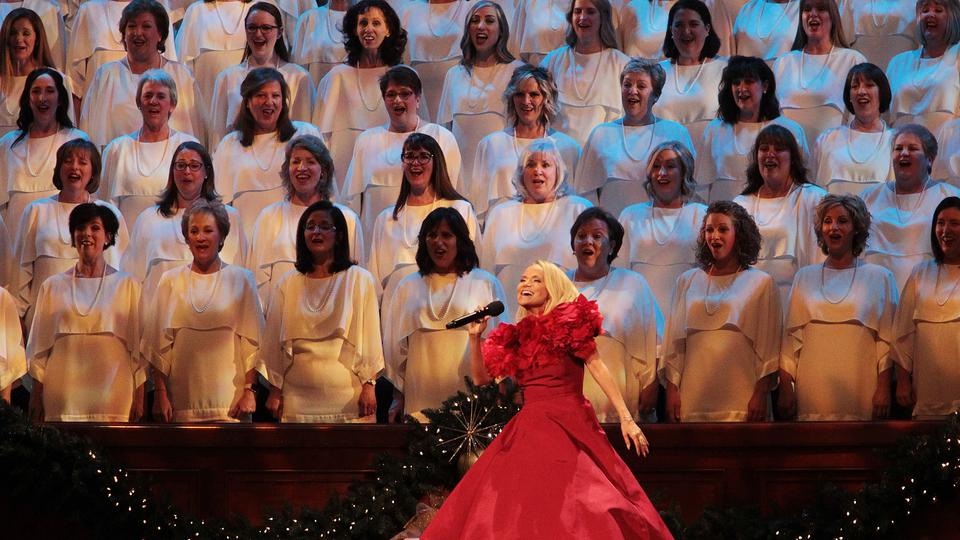
Tabernacle Choir Christmas Concert
Guest artist Kristin Chenoweth performs at the Tabernacle Choir Christmas Concert December 13 through 15, 2018, in the Conference Center on Temple Square.2018 by Intellectual Reserve, Inc. All rights reserved.This story appears here courtesy of TheChurchNews.com. It is not for use by other media.
By Mary Richards, Church News
Editor’s note: In the second of a two-part series, the Church News looks at new hymns that come from other Christian traditions. Part 1 offers a list of such new hymns from African American, Swedish, Dutch, French, Scottish and other origins.
As leaders of The Church of Jesus Christ of Latter-day Saints and the Hymnbook Committee have been working on the new global hymnbook, “Hymns — For Home and Church,” they have carefully considered many selections, including existing hymns from other Christian traditions and hymns and songs from the current non-English Church hymnbooks.
Below is a list of hymns from other Christian traditions that The Tabernacle Choir at Temple Square sang before they were included in the new hymnbook.
Information about each of these hymns comes from the resource called “About the Hymns” section of the Gospel Library, also found linked under the “lyrics” view of each hymn.

‘Come, Thou Fount of Every Blessing’
“Come, Thou Fount of Every Blessing” was written by English pastor and hymn writer Robert Robinson, who had a life-changing experience at age 16.
Robinson attended a religious revival meeting in London, England, with the desire to heckle the minister. Instead, he left the meeting changed and deeply convinced of his own sinfulness. In his early 20s, he became a preacher himself and wrote “Come, Thou Fount of Every Blessing,” his powerful plea for God’s mercy and forgiveness, explains the chapter about this hymn.
The song has been included in most Protestant hymnals in England and the United States and was included in Emma Smith’s second hymn collection, published in Nauvoo, Illinois, in 1841. Later it was paired with an American folk tune for singing. But by 1985, it was not being sung frequently by members of the Church and was not included in the 1985 hymnal.
The current arrangement for the hymn was written by Mack Wilberg while he was director of the Brigham Young University Men’s Chorus. Then, when the Tabernacle Choir sang it under his direction, a new appreciation grew for the hymn, and it was the most-requested song when Church members were asked to share which songs they want added to the new collection.
‘It Is Well with My Soul’
Horatio G. Spafford wrote “It Is Well with My Soul” in 1876 as a hymn of comfort and hope after deep sorrow and heartbreaking loss.
First, Spafford lost his business. Then his young son died from scarlet fever. Then Spafford’s wife and four daughters were traveling to Europe in 1873 when their ship sank in the Atlantic Ocean. His wife was pulled from the water but the children died.
While Spafford was crossing the Atlantic to meet Anna, his ship reached the site where the shipwreck had occurred. But he did not think of his loved ones being there; he knew that they were safe and cared for in heaven, explains the chapter about this hymn. The tune, composed by Philip P. Bliss, is named “Ville du Havre” after the lost ship.

Christian hymns 2
Actors portraying the story of Horatio and Anna Spafford and how he wrote “It Is Well With My Soul” perform during The Tabernacle Choir at Temple Square’s Christmas concert in Salt Lake City on Thursday, December 14, 2017. Photo by Jeffrey D. Allred, courtesy of Church News.Copyright 2025 Deseret News Publishing Company.A June 3 post on the choir’s social media pages said, “‘It Is Well with My Soul’ was performed during the last general conference, and a few tears were shed as our choir members felt the deep emotion and love in this powerful hymn.”
The hymn was sung and its story told during “Music & the Spoken Word” on June 7, 2017, and its background was also told by actor Hugh Bonneville during the choir’s 2019 Christmas concert.
‘His Eye Is on the Sparrow’
Civilla D. Martin wrote many hymns and gospel songs. In 1905, she and her husband became friends with the Doolittles, a couple who had both suffered from disabling health problems for many years. The chapter about this hymn explains that one day the Martins asked Mrs. Doolittle how she kept from becoming discouraged with all her difficulties. “How can I be discouraged,” she replied, “when my Father watches the sparrows, and I know He loves and cares for me?”
This prompted Martin to write “His Eye Is on the Sparrow.” She sent it to Charles H. Gabriel, author and composer of “I Stand All Amazed,” and he composed the music to accompany her text.
The Tabernacle Choir at Temple Square performed this hymn in April 2024 general conference. It was in the collection of the first 13 songs released for the new hymnbook in May 2024.

‘Amazing Grace’
The more-than-250-year-old “Amazing Grace” is perhaps one of the world’s best-known and most popular Christian hymns.
The chapter about this hymn says that the author, John Newton, had lived a tumultuous life, and as a sailor, he was involved in the African slave trade. During a brutal storm off the coast of Ireland in 1748, Newton prayed to be spared from shipwreck, later writing, “I thought … there never was, nor could be, such a sinner as myself.”
After that experience, Newton began reading the Bible, had a spiritual conversion and became an Anglican minister. He fought against the slave trade and lived to see it abolished in the British Empire in 1807.
The text of “Amazing Grace” was included in the Church’s 1841 hymnbook, and the music is an American folk tune of the 19th century.
The Tabernacle Choir at Temple Square has sung it numerous times, including during a tour of the southern United States in 2001 and on the banks of the Missouri River in Council Bluffs, Iowa, in 2009.
‘My Shepherd Will Supply My Need’
Isaac Watts wrote “My Shepherd Will Supply My Need” in 1719, based on Psalm 23.
When Watts was a child, the hymns that were sung at worship services were based on the book of Psalms. But Watts was not satisfied with the psalm-based hymns of the time and tried a new approach: using New Testament language to emphasize Christ as the central figure of the book of Psalms, explains the chapter about this hymn.
The music to “My Shepherd Will Supply My Need” is an American folk tune from 1828 and was arranged in 2024 by the Church. It was on the list of favorite hymns that Church News readers listed in 2018 as hymns they hoped to see in the new hymnbook.
The Tabernacle Choir sang it in October 2024 general conference, while the choir and orchestra’s performance on YouTube from September 2024 has tens of thousands of views.
‘Softly and Tenderly Jesus Is Calling’
Will L. Thompson wrote the words and music to “Softly and Tenderly Jesus Is Calling” in 1880.
Latter-day Saints will recognize other hymns written by Thompson that are in the 1985 hymnal, including “Have I Done Any Good?” and “Put Your Shoulder to the Wheel.”
Thompson was a devout member of his local Presbyterian church in Ohio, explains the chapter about this hymn, and he always carried a notebook with him. He said: “If an idea or theme comes to me … I jot it down in verse. … As I write the words of a song, a fitting melody is already in my mind.”
The women of the Tabernacle Choir sang Wilberg’s arrangement of this hymn during a “Music & the Spoken Word” episode in 2013. Another rendition with soloist Madison Leonard aired in 2023.
‘Standing on the Promises’
Russell Kelso Carter wrote the lyrics and music to “Standing on the Promises” in 1886 while teaching at a military academy. For many years before, Carter struggled with extreme fatigue because of heart problems. Medical doctors at that time were unable to offer him solutions. Finally, in desperation, Carter turned to faith and prayer, explains the chapter about this hymn. When he returned to health, he credited his remarkable healing to God’s power.
Throughout the rest of his life, Carter found strength by focusing on the Savior’s promises.
The Tabernacle Choir sang it during a “Music & the Spoken Word” episode on Aug. 6, 2023.
‘His Voice as the Sound’
Author Joseph Swain became a Baptist minister after an experience he had in his 20s where he felt “the presence of God in [his] soul.” Before that, he had only used his gift for language to write songs for the enjoyment of himself and his friends in 18th-century London, explains the chapter about this hymn.
“His Voice as the Sound” takes its text from portions of Swain’s poem “A Description of Christ.” Parts of the poem’s original nine stanzas have been used in many hymn texts, including in “Redeemer of Israel” and “My Song in the Night.” The words to this hymn were paired with an American folk tune in 1820.
The Tabernacle Choir included this hymn in their 2009 album “Come Thou Fount of Every Blessing: American Folk Hymns and Spirituals.” A version was sung during “Music & the Spoken Word” in 2013 as well.
‘Hail the Day That Sees Him Rise’
The Easter hymn “Hail the Day That Sees Him Rise” was written in 1739 by Charles Wesley, who is considered to be one of the greatest English hymn writers of all time.
Wesley wrote more than 6,000 hymns for many religious and personal occasions, explains the chapter about this hymn. He was a traveling preacher when he wrote this hymn to celebrate Ascension Day.
For “Hymns — For Home and Church,” Wesley’s text has been paired with music composed in 1817 by Robert Williams, a basketmaker from the Isle of Anglesey in Wales. Williams was blind from birth and a talented musician who could write down a tune perfectly after hearing it only once.
Watch the Tabernacle Choir and Orchestra at Temple Square perform this hymn in this video posted in June 2024.
https://www.youtube.com/watch?v=jAAbsKihzuI
‘What Child Is This?’
“What Child Is This?” is a well-known Christmas carol that was written by William Chatterton Dix in Great Britain in 1867. It has been included in many hymnals of other faiths.
Dix is best known for his Christmas hymns. He was neither a minister nor a scholar, but he had a finely honed gift for writing religious texts, explains the chapter about this hymn.
Dix’s text was set to the tune of the 16th-century English melody “Greensleeves.” John Stainer, an accomplished composer, harmonized the tune for the hymn’s publication in 1867.
The Tabernacle Choir has recorded it in the past and sung it over the years at Christmastime, including during their 2018 Christmas concert with Kristin Chenoweth.
‘Still, Still, Still’
“Still, Still, Still” is an Austrian carol that originated from the Salzburg region — an area known for beautiful mountains and music, explains the chapter about this hymn.
The author is anonymous, and the song was passed down by oral tradition and first published in 1865 in “Salzburgische Volks-Lieder” (“Salzburg Folk Songs”), a volume of 1,000 folk songs selected by Maria Vinzenz Süss, founder of the Salzburg Museum.
Süss wrote in the preface that “Salzburgers, both mountain dwellers and lowlanders, gifted by their Creator with sound knowledge, cheerful humor and a pure voice, are unrivaled by any other people in singing.”
An arrangement by Wilberg was performed by the Tabernacle Choir in December 2013, December 2018 and December 2024.